3. How do you find out about new RPGs?
Pre-Internet Era (P.I.E.)
In the first ten years of my involvement with role-playing games, I learned about new RPGs from three sources:
1. The shelves of my favorite local game shop
2. DRAGON Magazine
3. White Dwarf
Early Internet Era (E.I.E.)
I didn't have Internet access until 1999, but once I did, it became my primary news source for RPGs. I routinely visited free RPG sites and An Encyclopedia of Role-Playing Games. I subscribed to Pyramid before Steve Jackson Games converted it into a less frequent PDF. I avidly read Places to Go, People to Be; Imazine; and Critical Miss: The Magazine for Dysfunctional Roleplayers. And I read lots and lots of gaming Web logs.
Internet Onwards (I.O.)
The three game shops I relied upon for most of my RPG purchases are long gone. There are four or five game shops in my area, but only one stocks RPGs, and none that interest me. Nowadays, I gain most of my knowledge about new RPGs from these sources:
1. Google+
2. Web logs
3. podcasts
I'd add Kickstarter, but I usually hear about RPG Kickstarter projects from Google+, Web logs, or podcasts first.
If I am any indication of a trend, then I think it behooves all of us who love the hobby to share our discoveries on our Web logs, podcasts, and Google+ posts (and any other word-of-mouth methods we can think of, such as, say, word of mouth).
[For more information on #RPGaDAY (or #RPGaDAY2017 specifically), read this.]
03 August 2017

02 August 2017
RPGaDAY 2017: Day 02
2. What is an RPG [game, world, or adventure] you would like to see published?
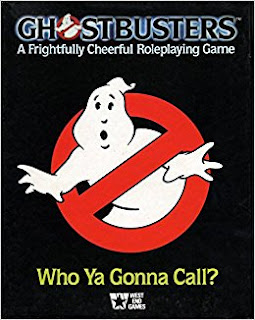
My first instinct is to say a reprint of the original Ghostbusters role-playing game, preferably with an accompanying booklet that condenses the rules (and offers a binary randomizer option similar to that used in Prince Valiant) and higher quality equipment cards (with an emphasis on durability).
Otherwise, I would like to see a Flash Gordon, Buck Rogers, or Barbarella game based on the Prince Valiant rules system.
A Fudge or Sherpa conversion of Timeship would also be welcome (especially if I am hired to convert it).
[For more information on #RPGaDAY (or #RPGaDAY2017 specifically), read this.]

My first instinct is to say a reprint of the original Ghostbusters role-playing game, preferably with an accompanying booklet that condenses the rules (and offers a binary randomizer option similar to that used in Prince Valiant) and higher quality equipment cards (with an emphasis on durability).
Otherwise, I would like to see a Flash Gordon, Buck Rogers, or Barbarella game based on the Prince Valiant rules system.
A Fudge or Sherpa conversion of Timeship would also be welcome (especially if I am hired to convert it).
[For more information on #RPGaDAY (or #RPGaDAY2017 specifically), read this.]
01 August 2017
RPGaDAY 2017: Day 01
1. What published RPG [game, world, or adventure] do you wish you were playing right now?

I am in the mood to play multiple role-playing games and settings at any moment, but at this exact moment I feel the urge to play Teenagers from Outer Space by Mike Pondsmith. Published by R. Talsorian Games in the late 1980s, it is "set on an Earth where fun-loving space aliens go to our high schools and party with the Earth kids. In the game you play the part of a teenager—alien or human—and have adventures fighting mutant monstrosities, saving the world from ravening rabbits from the X dimension, and getting your homework in on time." In other words, you engage in sci fi teenage high jinks.
The game system is simple and transparent (features I find very attractive and all too rare), and the writing is whimsical without being forced. The character attributes (or Statistics) offer a clear picture of the flavor of the game: Smarts, Bod, Relationship with Parents, Luck, Driving, Looks, Cool, and Bonk. (Bonk is how much punishment you can take.)
The cover art for the two editions offer somewhat different visions of the game. The first, by Mike Ebert, is suggestive of manga, whereas the second, by Wayne Barlowe, reflects the 1980s America in which the game was written. My own instincts draw me inexorably toward a sci fi 1950s interpretation inspired by the movie that inspired the game's title (plus every other sci fi and/or monster movie of the 1950s). Or a blend of all three.
Teenagers from Outer Space is light, easy, comedic fun, which is exactly what I'm in the mood for right now.
[For more information on #RPGaDAY (or #RPGaDAY2017 specifically), read this.]
08 June 2017
The Armor Class Equalizer
Sometimes the best weapons to use against armored opponents are not those that inflict the most damage, but those that deprive them of the advantage of wearing armor. Armor is best for deflecting or absorbing attacks, but it is the worst for avoiding attacks. The mounted knight or man-at-arms is particularly vulnerable to the hooked pole arms used by footmen and peasantry to pull them off their steeds.
This is a simple rule that can be added to any role-playing game that utilizes armor class in combat resolution.
Any attacker who uses an appropriate weapon with the intent of pulling, pushing, toppling, entangling, or unhorsing an opponent may consider that opponent to be unarmored in terms of armor class regardless of whatever armor that opponent may be wearing. If the opponent is aware of the attack and able to react, the opponent's armor class will be modified by his or her Dexterity bonus or penalty, if any. Appropriate weapons include whips, bolas, man-catchers, and most pole arms (namely those with hooks and/or tines). If the attack is successful, it causes no damage, but the victim is affected as follows:
Effects may be adjudicated by GM fiat, GM-player negotiation, attribute checks, or any extant rules covered by the system being used.
This is a simple rule that can be added to any role-playing game that utilizes armor class in combat resolution.
Any attacker who uses an appropriate weapon with the intent of pulling, pushing, toppling, entangling, or unhorsing an opponent may consider that opponent to be unarmored in terms of armor class regardless of whatever armor that opponent may be wearing. If the opponent is aware of the attack and able to react, the opponent's armor class will be modified by his or her Dexterity bonus or penalty, if any. Appropriate weapons include whips, bolas, man-catchers, and most pole arms (namely those with hooks and/or tines). If the attack is successful, it causes no damage, but the victim is affected as follows:
- whip: entangled (potentially tripped or disarmed)
- bola: entangled (potentially tripped)
- man-catcher: caught (potentially pushed or pulled)
- pole arm: unhorsed or tripped
Effects may be adjudicated by GM fiat, GM-player negotiation, attribute checks, or any extant rules covered by the system being used.
23 October 2016
The Thieves' Guild: A Guild Full of Thieves!
As far as I can tell, the only examples of a thieves' guild that predate Dungeons & Dragons are in two stories, one by Fritz Leiber and one by Miguel de Cervantes. My guess is that D&D only has them because of Leiber (and only has "Read Magic" as a skill for thieves because of Leiber's Grey Mouser, which is odd because his spellcasting ability was clearly due to his early apprenticeship to a hedge wizard and quick abandonment of that profession).
At any rate, I think it's interesting that an idea presented in fiction (and probably intended as an isolated or rare example) was adapted to be not just a common feature to all cities in a given game setting, but all cities in the game regardless of setting. Thieves' guilds, to my mind, should be an anomaly, limited to very unusual cities. Perhaps limited to one city per continent, if not one per world. Far more common, I think, would be cities full of gangs and rival criminal networks. These are better fodder for standard adventure plot hooks and random entanglements. A thieves' guild should be what it was intended to be by the writers who invented it: an exotic social structure that is almost a world unto itself. It should be an alternative to the player characters' typical experiences with the criminal element, something that puts them off balance, like a subculture or alien culture encountered for the first time.
I'll be house-ruling thieves' guilds out of existence in my own campaigns (except for isolated cases) and replacing them with gangs. Thieves' guilds should be unique, not ubiquitous.
(Thieves' Guild, the game of thieves and their guilds by Gamelords Ltd., is a topic for another day.)
At any rate, I think it's interesting that an idea presented in fiction (and probably intended as an isolated or rare example) was adapted to be not just a common feature to all cities in a given game setting, but all cities in the game regardless of setting. Thieves' guilds, to my mind, should be an anomaly, limited to very unusual cities. Perhaps limited to one city per continent, if not one per world. Far more common, I think, would be cities full of gangs and rival criminal networks. These are better fodder for standard adventure plot hooks and random entanglements. A thieves' guild should be what it was intended to be by the writers who invented it: an exotic social structure that is almost a world unto itself. It should be an alternative to the player characters' typical experiences with the criminal element, something that puts them off balance, like a subculture or alien culture encountered for the first time.
I'll be house-ruling thieves' guilds out of existence in my own campaigns (except for isolated cases) and replacing them with gangs. Thieves' guilds should be unique, not ubiquitous.
(Thieves' Guild, the game of thieves and their guilds by Gamelords Ltd., is a topic for another day.)
07 October 2016
Listen to the Sounds of the Aftermath
17 July 2016
Not Necessarily Beautiful, But Mutated
The Mutant Crawl Classics RPG Kickstarter is rapidly approaching End Times, so back it already! To accelerate your mutation, I encourage you to listen to these interviews with the game's creator, Jim Wampler:
30 June 2016
The Mutants Are Coming
I still haven't had a chance to run or play Dungeon Crawl Classics RPG yet (although I backed the 4th printing Kickstarter project and I now have the softcover copy as I wait for the hardcover copy to be shipped), and now I have this tempting me: the Mutant Crawl Classics Kickstarter project. It's perfectly reasonable as far as Kickstarter projects go, so I'd be kicking myself if I missed the chance to back it...
Blasted Kickstarter.

Blasted Kickstarter.

24 May 2016
Complimentary Critical Hit Table
Far too much of my game collection has been hidden in boxes for far too long. Yesterday, I finally bought a large baker's rack (now a gamer's rack) to hold most of my games, and as I was unpacking I came upon this artifact from my early gaming history...

It's a complimentary critical hit table from Diamond Dice Inc. included with an order. I must have acquired it in the 1980s because I distinctly recall using this table when I ran AD&D in high school. I allowed my players to vote on whether the table should be used in our game and they voted unanimously in favor (knowing full well that it had an even chance of being used against them). The author is anonymous, but if he or she is reading this, I would like to say thanks for providing many entertaining consequences for my players' actions.
Here is the text of the table from Diamond Dice Inc.:

It's a complimentary critical hit table from Diamond Dice Inc. included with an order. I must have acquired it in the 1980s because I distinctly recall using this table when I ran AD&D in high school. I allowed my players to vote on whether the table should be used in our game and they voted unanimously in favor (knowing full well that it had an even chance of being used against them). The author is anonymous, but if he or she is reading this, I would like to say thanks for providing many entertaining consequences for my players' actions.
Here is the text of the table from Diamond Dice Inc.:
30 Sided Die Stock # 98B
HIT RESULT TABLE
Most fantasy role-playing systems utilize a combat result which takes the form of "x" amount of damage points per blow. This table should be used after you have determined a critical hit has been scored. I would suggest that the table be consulted on a roll of "20", all other hits would be treated normally. The table will personalize the damage done and produce some interesting character deficiencies.
30 Instant death, skull has been crushed
29 Spinal cord severed, crippled for life
28 Leg severed, game master will determine which one
27 Arm severed, game master will determine which
26 Eye penetrated, game master will determine which eye has lost sight
25 Hand severed, game master will determine which one
24 Groin damage, no longer capable of sexual activity
23 Throat damaged, loss of speaking ability
22 Lung punctured, loss of constitution determined by game master
21 Shoulder bone crushed, loss of strength determined by game master
20
19
18
17
16 Result is as normal, critical hit avoided by character
15
14
13
12
11
10 Fingers chopped off, loss of dexterity determined by game master
9 Ear lopped off, loss of hearing in that ear due to scarring
8 Glancing blow on scalp, most of hair gone, loss of charisma
7 Brain damage, loss of memory
6 Arm damaged, may not use for randomized period of time
5 Leg damaged, walk with a limp
4 Crushing blow to mouth, teeth knocked out, loss of charisma
3 Nose crushed, lose sense of smell, loss of charisma
2 Facial wounds, scars on face reduce charisma
1 Buttocks slashed, you can't sit down for a week
17 April 2016
Options for Magic Scroll Manufacturing
This may be heresy, but I am thinking of adding the Holmes Basic scroll rules to my Swords & Wizardry White Box game, but with one change: Instead of requiring one week per spell level to inscribe a spell, I'd reduce it to one day per spell level. In a campaign in which adventures occur in rapid succession due to certain events, there is very little time for study between them. Taking a week between adventures just to inscribe one first level spell simply isn't worth the time and effort even if a week can be spared. A fourth level spell requires an entire month to inscribe, just so it can be used once. It would be more time and cost effective to manufacture a magic item that can accomplish the same effect.
As for the material cost, I'd rather leave it for the individual Referee to set based on his or her campaign needs and setting requirements. Holmes offers a good base cost of 100 gold pieces per spell level (or silver pieces in the case of my setting), but some Referees may prefer to send their player characters on quests for the exotic materials necessary for producing spell scrolls.
[Visit the Swords & Wizardry Appreciation Day 2016 Contribution Index for a list of Swords & Wizardry contributions and resources! Special thanks to R.J. Thompson, this year's host!]
As for the material cost, I'd rather leave it for the individual Referee to set based on his or her campaign needs and setting requirements. Holmes offers a good base cost of 100 gold pieces per spell level (or silver pieces in the case of my setting), but some Referees may prefer to send their player characters on quests for the exotic materials necessary for producing spell scrolls.
[Visit the Swords & Wizardry Appreciation Day 2016 Contribution Index for a list of Swords & Wizardry contributions and resources! Special thanks to R.J. Thompson, this year's host!]
Subscribe to:
Posts (Atom)